Skip to content
As a BetterHelp affiliate, we receive compensation from BetterHelp if you purchase products or services through the links provided
There is a specific reason we choose vinyl over streaming. If we just wanted to hear a song, we could tap a glass screen and have Spotify serve it up in milliseconds. But we don’t do this because we aren’t just looking for convenience; we are looking for a ritual. We want the tactile experience—the weight of the jacket in our hands, the slide of the inner sleeve, and that satisfying thump as the needle hits the groove.
However, that ritual is supposed to be a moment of decompression. It is meant to be the part of the day where the noise of the world fades away. But if your listening room looks like a disaster zone, that sense of peace evaporates before the music even starts.
You can’t relax if you are stepping over stacks of albums leaning precariously against the wall. You can’t find your flow if you spend twenty minutes hunting for that one Talking Heads album you swear you bought last year. This is where proper vinyl record storage becomes more than just furniture; it becomes a tool for mental clarity. The environment in which you listen to music is just as important as the speakers you listen through.
Here is why getting your collection off the floor and into a system is the ultimate act of self-care for the audiophile.
1. Eliminating Visual Noise
We often talk about the warm, analog sound of vinyl, but we rarely talk about the visual aspect of the hobby. Clutter creates what psychologists call visual noise. When your eyes scan a room and see piles, disarray, and chaos, your brain has to work harder to process the environment. It creates a low-level spike in cortisol (the stress hormone) that hums in the background of your mind.
If your records are shoved into milk crates, stacked horizontally on a desk, or overflowing from a bookshelf that wasn’t designed to hold them, your brain registers this as a task. It sees a mess that needs to be cleaned up.
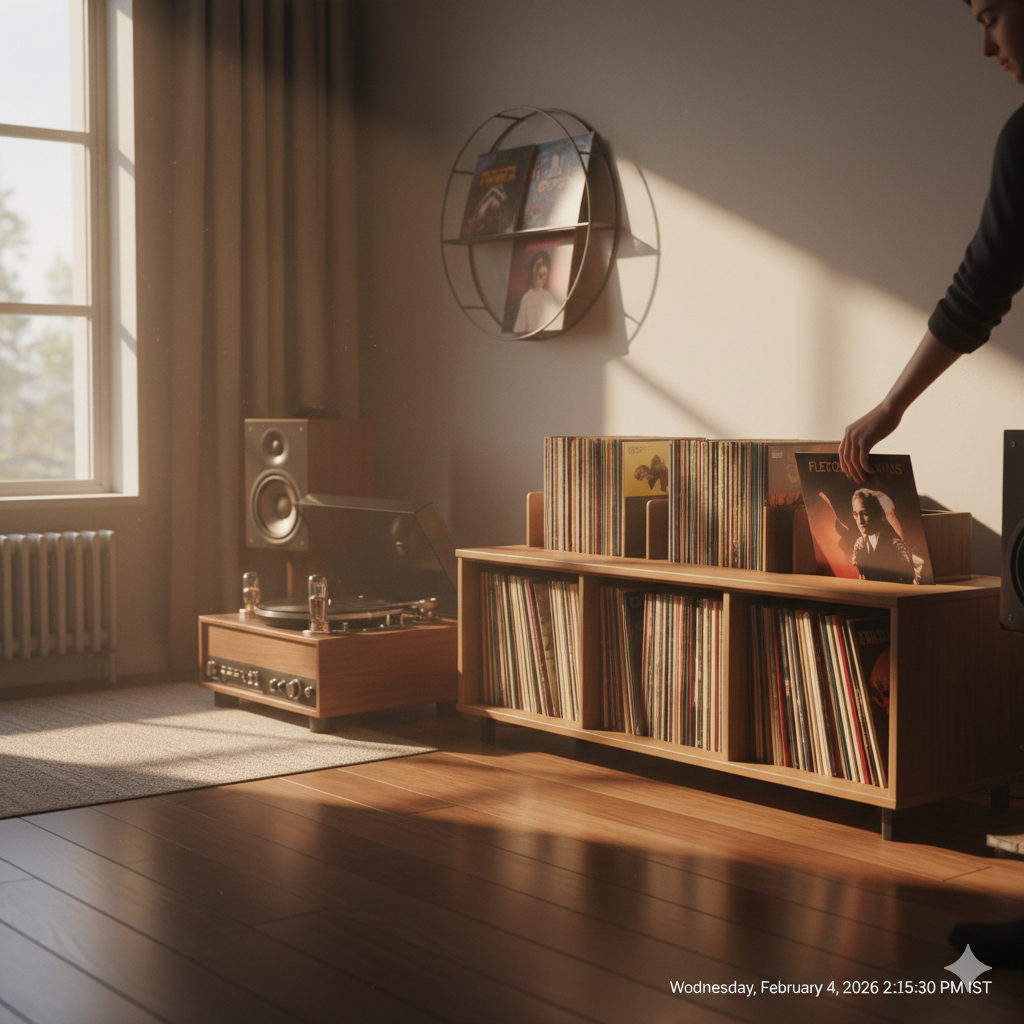
By organizing your collection into a dedicated, purpose-built console or shelving unit, you silence that visual noise. You turn a pile of clutter into a library. When you walk into the room, your eyes can rest. The albums become a curated display rather than a to-do list, allowing you to actually sit down and listen without that nagging feeling that you should be cleaning the room.
2. The Struggle of the Hunt
There is nothing more frustrating than knowing exactly what you want to hear and being physically unable to find it.
Music is often mood-dependent. You might have a sudden, intense craving for 70s jazz fusion or a specific rainy-day folk album. That impulse is fleeting. If you have to dig through three different unorganized stacks, lift heavy piles to check what’s underneath, or decipher a spine that has been crushed by poor storage, the impulse dies. The difficulty of the process kills the joy.
Organization removes the hassle. Whether you sort alphabetically, by genre, or even autobiographically (like High Fidelity), a system empowers you. It creates a direct line between the thought (“I want to hear Rumours“) and the action (holding Rumours). When your collection is organized, you listen to more music because the barrier to entry is gone. You stop defaulting to the same five records sitting on top of the turntable and start exploring the deep cuts of your own library.
3. The Anxiety of Damage
For most collectors, their vinyl library isn’t just a hobby; it’s a significant financial investment. We spend decent money on rare pressings, limited editions, and 180-gram reissues.
When records are stored haphazardly, they are under constant threat.

- Warping: Stacking records flat (on top of each other) creates immense pressure that warps the vinyl over time.
- Ring Wear: Packing them too tightly into a shelf ruins the artwork on the jacket.
- Sleeve Damage: Leaning a stack against a wall eventually causes the covers to bow and crease.
Subconsciously, this worries you. If you care about your collection, looking at a messy pile induces a specific kind of anxiety—the fear that your prized possessions are slowly destroying themselves.
Getting your records vertical, with proper spacing and support, alleviates this anxiety. There is a profound sense of calm that comes from knowing your collection is safe. You aren’t just organizing them; you are preserving them. You can sleep better knowing that your original pressing of The Dark Side of the Moon isn’t slowly bending into a taco shape under the weight of a Led Zeppelin box set.
4. Categorization as Meditation
The actual act of organizing your records can be incredibly therapeutic. In a world where so much of our work is digital and abstract, physically sorting your music is a grounding exercise.
It forces you to handle every album. You pull it out, look at the cover, remember where you bought it, and decide where it lives. It’s a trip down memory lane. You might rediscover an album you forgot you owned or find a receipt from a record store that closed ten years ago.
This process allows you to reconnect with your music. It is a slow, deliberate task that requires focus, pushing out the intrusive thoughts of the workday. Once the task is done, standing back and looking at a perfectly categorized shelf offers a dopamine hit of accomplishment that is hard to beat.
5. The Tactile Joy of Browsing
One of the most satisfying feelings in the world is standing at a record store bin and flipping through the stacks. Flip, flip, flip. It is rhythmic, hypnotic, and oddly calming.
You can recreate this feeling at home, but only if your storage allows for it. When records are jammed onto a shelf so tightly that you can’t pull one out without breaking a nail, or when they are stacked in a deep pile that hides the artwork, you lose that tactile connection. You stop browsing.
Proper organization—specifically storage that allows for breathing room—brings that record store magic into your living room. It invites you to engage with the physical object. You aren’t just reading a thin white spine; you are seeing the cover art as the artist intended. This turns the act of selecting a record from a stressful search into a pleasurable, slow-motion activity that centers you before the music even begins.
We collect vinyl because we love the experience. We love the intentionality of it. But that intentionality falls apart if the logistics are a mess.
Don’t let clutter rob you of the peace that music is supposed to bring. Treat your collection with the respect it deserves, and you will find that a tidy shelf doesn’t just look better—it actually sounds better.

- The Sleep-Well Account: Why Your Nest Egg Is Actually a Mental Health Tool - February 25, 2026
- A Guide for Turning Your RV into a Sanctuary for Sleep - February 4, 2026
- High Stakes, Low Blood Pressure: How to Navigate the Chaos of Moving Hazardous Liquids - February 4, 2026
This site contains affiliate links to products. We will receive a commission for purchases made through these links.