Skip to content

As a BetterHelp affiliate, we receive compensation from BetterHelp if you purchase products or services through the links provided
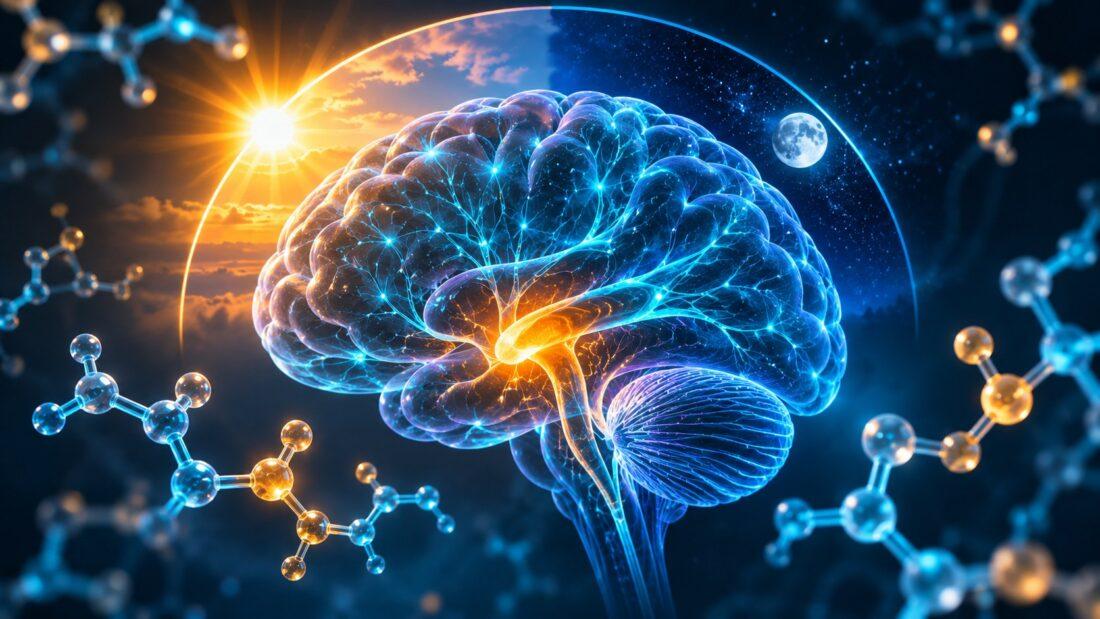
As darkness settles over a city, the human brain begins moving through a series of biological changes that have been developing throughout the day. Neural activity shifts, patterns of hormone secretion change, and the relationship between environmental signals and internal biological rhythms becomes increasingly apparent.
Sleep may appear to be a period of inactivity, but the sleeping brain remains engaged in numerous biological processes. Researchers studying these processes have discovered an intricate relationship between neural communication, metabolic regulation and the internal mechanisms that organize physiology across the day and night.
Peptides contribute to several aspects of this communication. Some participate in the coordination of biological clocks, while others are involved in signaling systems associated with energy regulation and physiological behavior. Understanding their functions provides an opportunity to examine sleep from a molecular perspective without confusing experimental discoveries with established therapeutic evidence.
The Biological Clock Is a Network Rather Than a Single Timer
Human physiology follows patterns that extend across approximately twenty-four hours. These circadian rhythms influence numerous biological characteristics, including body temperature, hormone secretion, alertness and the timing of various metabolic processes.
A small region of the hypothalamus known as the suprachiasmatic nucleus plays an important role in coordinating these rhythms. Often described as the central biological clock, this structure contains populations of neurons that communicate with one another and respond to information associated with environmental light.
However, the central clock does not operate independently of the rest of the body. Many tissues contain their own molecular timing mechanisms, which participate in the regulation of local cellular functions.
The relationship between central and peripheral clocks creates a coordinated biological system in which timing influences how different tissues perform their activities.
This organization helps explain why circadian science involves more than understanding when people become sleepy. Researchers are also investigating how biological timing affects the relationship between environmental conditions, cellular activity and physiological regulation.
How Peptide Signals Help Coordinate the Brain’s Internal Clock
Individual neurons within the suprachiasmatic nucleus must communicate effectively for the central clock to maintain coordinated rhythmic activity. Several molecular signaling systems contribute to this process.
One particularly interesting molecule is vasoactive intestinal peptide, commonly abbreviated as VIP. Despite its name, this naturally occurring peptide also performs signaling functions within the nervous system.
In April 2005, researchers publishing in Nature Neuroscience investigated the contribution of VIP signaling to circadian coordination. Their experiments involving genetically modified mice and neuronal cultures demonstrated that disruption of this signaling system affected the rhythmic behavior and synchronization of clock neurons.
The findings helped establish that communication between cells contributes to the collective behavior of the central circadian clock.

Further research published in the Journal of Neuroscience in 2018 examined VIP-producing neurons and their contribution to the adjustment of biological rhythms in response to environmental light. The investigators found that these neurons participated in the processes through which the circadian system responds to changing light conditions in mice.
These discoveries illustrate how peptide signaling can contribute to the organization of biological time. They do not establish that experimental peptide products can improve sleep or correct circadian disorders in humans.
Sleep Pressure and Circadian Timing Are Different Biological Processes
People often assume that the desire to sleep is determined entirely by the time displayed on a clock. In reality, sleep regulation involves interacting processes that can be influenced by previous wakefulness and internal biological timing.
Sleep pressure generally increases during prolonged wakefulness and declines during sleep. Circadian timing, meanwhile, influences the biological tendency toward wakefulness or sleep at different points within the daily cycle.
These processes help explain why someone may experience temporary alertness after being awake for many hours, even though the underlying need for sleep has increased.
Researchers studying sleep must account for both mechanisms when interpreting experimental findings. A change in alertness does not necessarily indicate a corresponding change in circadian timing. Similarly, an alteration in the timing of a biological rhythm does not independently establish that the physiological need for sleep has changed.
Educational information about molecular signaling, including material available through Peptides Lexington, can be better understood when these distinctions are recognized.
The biological function of an individual signaling molecule must be interpreted within the wider regulatory system in which it operates.
Why the Timing of Metabolism Matters to Sleep Researchers
Metabolism is commonly discussed in relation to food consumption and energy expenditure. From a biological perspective, however, metabolism also involves the timing of processes that determine how nutrients are detected, transformed, stored and utilized.
The liver, pancreas, skeletal muscles and other tissues perform metabolic activities that are influenced by both local biological conditions and signals originating elsewhere in the body.
These activities do not necessarily remain constant throughout the twenty-four-hour cycle. Differences in physiological timing can influence the relationship between nutrient availability and the body’s metabolic responses.
For scientists investigating endocrine communication, this creates an important consideration. An experimental observation obtained at one biological phase might differ from an observation obtained at another phase, even when other research conditions appear similar.
Studies examining research into metabolic signaling should therefore be interpreted within the context of the particular biological system and experimental conditions involved.
Changes in body weight, glucose regulation or cellular energy activity represent different types of observations. None independently establishes how an experimental substance affects sleep architecture, circadian coordination or long-term physiological function.
Understanding these boundaries allows researchers to investigate relationships between metabolic processes and sleep without assuming that every metabolic finding has implications for sleep quality.
The Sleeping Brain Remains Biologically Active
Sleep is not simply a period during which neural activity stops. Brain activity changes across different stages of sleep, producing characteristic patterns that researchers can examine using electrophysiological and other measurement techniques.
These changes provide opportunities to investigate how sleep relates to learning, memory and the regulation of neural communication.
In January 2014, Giulio Tononi and Chiara Cirelli published a review in Neuron examining the synaptic homeostasis hypothesis. This framework proposes that sleep contributes to the regulation of changes in synaptic strength associated with experiences during wakefulness.
According to the hypothesis, the adjustment of neural connections during sleep may help address biological demands associated with learning and the maintenance of efficient neural networks.
The framework remains an area of scientific investigation. It should not be interpreted as a complete explanation for every function of sleep.
Its significance lies partly in demonstrating how researchers can investigate recovery through carefully defined biological questions. Rather than treating recovery as a single measurable event, scientists examine specific cellular processes, neural characteristics and behavioral outcomes.
This distinction is particularly important when evaluating popular descriptions of substances that supposedly influence biological recovery. A change in one experimental measurement cannot establish that every recovery-related process has improved.
Why the Time of an Experiment Can Influence Its Results
Imagine two laboratories investigating the activity of the same biological signaling pathway. Both laboratories use comparable analytical methods, study similar experimental materials and collect measurements under apparently equivalent conditions.
However, one laboratory collects its observations during a particular phase of the biological cycle, while the second collects measurements during a different phase.
If the pathway under investigation is influenced by circadian regulation, the two laboratories could observe different responses without either investigation necessarily being incorrect.
This hypothetical example demonstrates why biological timing can become an important variable in experimental research.
The challenge becomes more complicated when comparing human and animal investigations. Many laboratory rodents are predominantly active during darkness, whereas humans are generally active during daylight. An equivalent clock time does not necessarily represent an equivalent biological phase across these populations.
Researchers must therefore consider whether experimental timing is appropriate for the question being investigated and whether the resulting observations can reasonably be compared with findings obtained under different conditions.
Clear reporting of relevant biological timing can help other investigators interpret research findings and identify potential explanations for differences between studies.
Biological Recovery Cannot Be Established Through a Single Marker
The concept of recovery appears frequently in discussions of sleep, exercise and general health. Within scientific research, however, recovery must be defined in relation to a particular biological or functional outcome.
A study examining the restoration of cognitive performance after sleep addresses a different question from an investigation measuring changes in cellular signaling. Similarly, research examining metabolic characteristics does not necessarily provide information about the restoration of neural function.
Biomarkers can help scientists investigate these questions by providing measurable information about biological activity. Nevertheless, their interpretation depends on the relationship between the measurement and the outcome of interest.
A marker associated with one physiological process may change without producing a measurable difference in another process. The significance of a biomarker also depends on the population, measurement method and circumstances under which it was studied.
These limitations help explain why credible scientific reports distinguish between molecular observations and demonstrated functional outcomes.
For peptide research, this means that descriptions of cellular activity should not be presented as proof of improved sleep, accelerated recovery or enhanced human performance unless those specific outcomes have been established through appropriate evidence.
Reading Sleep and Peptide Research Without Overinterpreting the Evidence
The growing availability of biotechnology information provides opportunities for people to understand scientific subjects that were once primarily discussed within academic institutions.
However, readers need to recognize the differences between explanatory material, experimental findings and established medical evidence.
When exploring this educational resource or similar biotechnology information websites, readers should consider whether scientific statements clearly identify their underlying evidence and acknowledge relevant limitations.
Research involving naturally occurring peptides should not be confused with evidence supporting the use of independently marketed experimental compounds. The discovery that a molecule performs an important biological function does not establish that externally supplied versions of that molecule are appropriate for human use.
It is equally important to distinguish research conducted in isolated cells, animal models and human participants. Each approach addresses different scientific questions and contributes different types of information.
Responsible scientific communication preserves these distinctions, allowing readers to appreciate the significance of emerging discoveries without assigning those discoveries conclusions that remain unsupported.
Understanding Biological Time Is a Continuing Scientific Challenge
The relationship between sleep, peptide signaling and metabolism illustrates how biological processes are organized across multiple levels of regulation. Molecular signals influence cellular activity, neural networks coordinate physiological timing, and tissues respond to conditions that change throughout the daily cycle.
Researchers continue to investigate how these systems interact and how their behavior varies across experimental environments and biological populations.
The most valuable discoveries in this field will depend on precise questions, reliable measurements and careful consideration of the circumstances surrounding each observation.
Peptide signaling offers an important perspective on the communication systems involved in biological timing. Sleep research provides another perspective on how neural and physiological functions change across periods of wakefulness and rest.
Bringing these perspectives together can improve scientific understanding of living systems. Their value lies in explaining biological complexity through evidence, rather than promising shortcuts to better sleep or faster recovery.

- The Science of the Sleeping Brain: How Peptide Signaling Connects Circadian Rhythms, Metabolism and Biological Recovery - November 28, 2026
- Why the Brain Connects Hunger With Wakefulness: What Orexin and Metabolic Peptide Research Reveal About Sleep Biology - November 28, 2026
- The Science of Sleep and Cellular Recovery: Understanding the Role of Peptide Signaling in Biological Research - November 24, 2026
This site contains affiliate links to products. We will receive a commission for purchases made through these links.