Skip to content

As a BetterHelp affiliate, we receive compensation from BetterHelp if you purchase products or services through the links provided
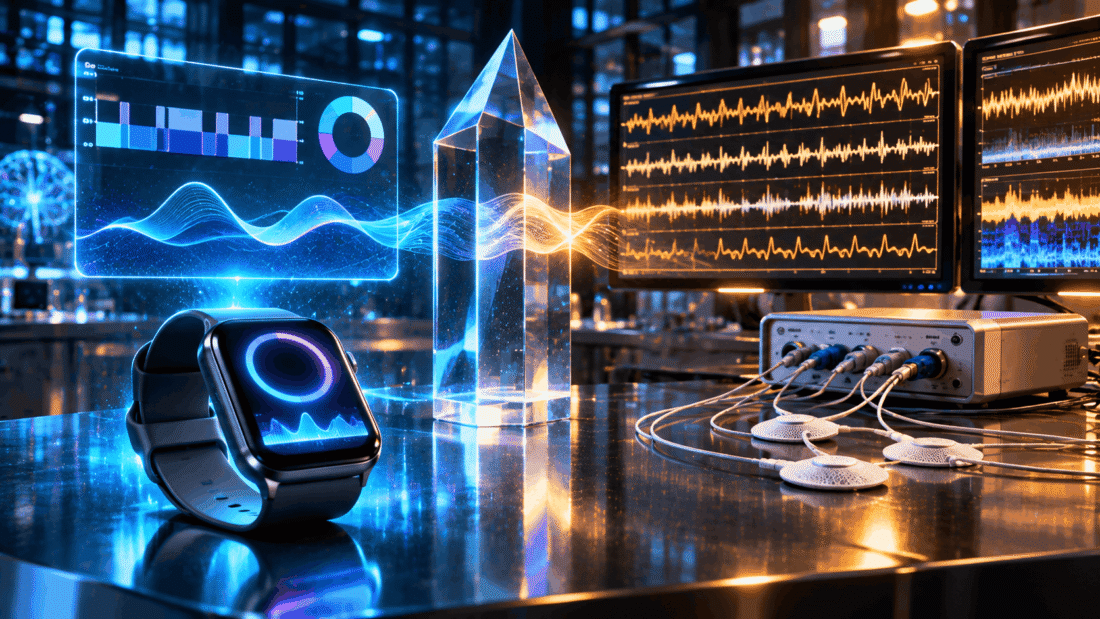
A sleep tracker reports eight hours of rest. The app displays a reassuring score, a neatly divided chart of light and deep sleep, and a precise estimate of rapid eye movement sleep. It appears to be a detailed account of what happened overnight.
But if that same night were examined in a sleep laboratory, the measurements might tell a different story.
The laboratory could identify periods of wakefulness that the wearable classified as sleep. Its estimates of rapid eye movement sleep might differ from the app’s calculations. Even the total number of minutes spent asleep could change depending on the measurement method.
This discrepancy does not mean that consumer trackers are useless. It means their numbers are estimates generated from particular sensors and computational methods, not direct observations of every process occurring during sleep.
The distinction matters when people use sleep scores to evaluate their health. It matters even more when researchers investigate experimental compounds, including peptides, and attempt to determine whether a biological measurement represents a genuine improvement in sleep.
Before a number can support a scientific conclusion, investigators need to understand what the measurement detects, how accurately it performs and which questions it cannot answer.
What a consumer sleep tracker actually measures
Most consumer wrist-worn sleep trackers do not directly record the brain activity used in conventional laboratory sleep staging.
Instead, they collect signals such as body movement and, in many devices, information derived from optical measurements of blood-volume changes near the skin.
The optical approach is commonly called photoplethysmography, or PPG.
Algorithms analyze those signals and estimate whether the wearer is asleep or awake. Some devices also estimate periods corresponding to light, deep and rapid eye movement sleep.
These calculations can be useful for identifying broad patterns over time. However, the signals are indirect.
A person may lie still while awake. Movement during sleep can also occur without indicating a prolonged awakening.

Similarly, changes in cardiovascular signals may be associated with sleep states without uniquely identifying them.
The resulting sleep-stage classification depends on the device’s sensors, signal quality, algorithms and the population in which those algorithms were evaluated.
Consequently, a reported sleep score should be interpreted as a product of the measurement system rather than an unrestricted statement about physiological recovery.
Why polysomnography is the reference standard
Polysomnography, commonly abbreviated PSG, is a comprehensive sleep study used in clinical and research settings.
It records several physiological signals that help trained professionals evaluate sleep and selected sleep-related abnormalities.
These signals commonly include electroencephalography to assess brain electrical activity, electrooculography to record eye movements and electromyography to assess muscle activity.
Depending on the examination, additional monitoring may include breathing, oxygen saturation, heart activity and body position.
The combination enables investigators to classify sleep stages using established scoring criteria.
This differs from a wristband making predictions based largely on movement and cardiovascular signals.
Polysomnography is not free from limitations. Laboratory conditions may differ from a person’s usual bedroom, and scoring involves defined professional procedures.
Nevertheless, it supplies a detailed physiological reference against which consumer sleep-tracking methods can be evaluated.
That is why many device-validation studies compare wearable estimates with measurements obtained during the same night of laboratory monitoring.
What the 2025 meta-analysis found when trackers met laboratory testing
In March 2025, Young Jeong Lee and colleagues published a meta-analysis in the Journal of Clinical Sleep Medicine examining the performance of consumer wrist-worn sleep trackers against polysomnography.
The researchers combined information from 24 studies involving 798 participants.
The evaluated devices included products from several manufacturers and differed in their sensors and measurement approaches.
Across the included studies, the analysis identified statistically significant differences in total sleep time, sleep efficiency, sleep latency and wake after sleep onset.
The pooled mean difference for total sleep time was approximately 17 minutes in one direction, while the difference in wake after sleep onset was approximately 13 minutes in the other.
Those figures are averages across varied studies, not correction factors that can be applied to every individual watch.
The researchers also examined subgroups and observed differences among device categories.
Their conclusion was that wrist-worn consumer devices remain less dependable than polysomnography for several key sleep parameters, although they may provide useful information about general sleep patterns.
The finding does not imply that every device makes the same error. It shows why precise-looking app results require appropriate scientific context.
Why eight hours on a screen may not mean eight hours asleep
Total sleep time is the amount of time classified as sleep during a measurement period.
It is different from simply recording how long someone was in bed.
A person could spend eight hours in bed but remain awake for part of that period.
If the person lies quietly, a movement-based algorithm may have difficulty separating still wakefulness from sleep.
That can affect the estimated number of minutes asleep.
Other devices may use additional signals that improve certain classifications but introduce different limitations.
The accuracy of a specific total-sleep-time estimate therefore depends on how the device identifies sleep onset, awakenings and the end of the sleep period.
A result that closely matches a laboratory assessment on one night does not establish that the device will be equally accurate on every subsequent night.
Researchers evaluate accuracy across participants and nights because errors may vary with individual sleep characteristics and the duration of waking periods.
Why rapid eye movement sleep is difficult to estimate from the wrist
Rapid eye movement sleep, often abbreviated REM sleep, is a distinct physiological stage identified through characteristic combinations of brain activity, eye movements and muscle tone.
Its identification during polysomnography relies on those physiological signals.
A wrist-worn device typically lacks the full set of measurements used in laboratory scoring.
Instead, its algorithm estimates REM sleep from signals that may be correlated with that stage.
Correlation can support a useful prediction model, but it does not make the indirect signals identical to the underlying physiological process.
Some devices classify REM sleep reasonably well under certain testing conditions, while others show meaningful disagreement.
Accuracy may also differ according to the particular device, population and amount of REM sleep present during a night.
As a result, a reported increase in REM minutes cannot automatically establish that REM sleep genuinely increased by the same amount.
That distinction matters when a study proposes that an intervention changes sleep architecture.
What the 2024 comparison of three popular devices revealed
A study published in Sensors in October 2024 evaluated the Oura Ring Gen3, Fitbit Sense 2 and Apple Watch Series 8 against polysomnography.
The researchers enrolled 35 adults between the ages of 20 and 50 who did not have a diagnosed sleep disorder.
Participants underwent a single night of inpatient laboratory monitoring while wearing the consumer devices.
The comparison provided information about how those specific devices performed under a shared measurement environment.
Importantly, differences among devices meant that accuracy could not be described by a single universal claim about wearables.
Performance also varied by the sleep measurement being examined.
The study’s participants were relatively healthy adults, and each person contributed one monitored night.
That design provides useful validation evidence but does not establish identical performance in people with insomnia, sleep-related breathing disorders or other conditions.
Nor does it guarantee that future software versions will reproduce the same results.
The study illustrates why researchers must name the device, describe its version and specify which sleep measurement was evaluated.
Why the sleep efficiency score can be misleading
Sleep efficiency is commonly expressed as the proportion of time in bed, or a defined sleep period, that was spent asleep.
Its numerical value depends on how the relevant time boundaries and sleep intervals are defined.
If a wearable incorrectly identifies periods of quiet wakefulness as sleep, its sleep efficiency estimate may be affected.
Differences in identifying sleep onset or morning wakefulness can also change the denominator used in the calculation.
These issues mean a high efficiency score is not necessarily a comprehensive measure of restorative sleep.
It describes a particular calculated relationship between time and estimated sleep.
Researchers may need additional information about sleep continuity, disturbances and daytime functioning to evaluate a broader clinical question.
The 2025 meta-analysis found that consumer devices and polysomnography differed significantly in pooled sleep-efficiency estimates.
That result reinforces the importance of identifying the measurement method before treating a score as proof of a meaningful change.
Why a device may miss brief awakenings
Awakenings do not always involve substantial body movement.
Someone may wake briefly, remain still and return to sleep without remembering the event later.
A wearable that relies partly on movement may classify some of these intervals differently from polysomnography.
The resulting discrepancy can influence total sleep time, wake after sleep onset and sleep efficiency.
In 2024, researchers published a comparison of five commercial sleep-tracking devices with research-grade actigraphy and polysomnography in Sensors.
The study involved 53 young adults monitored for one night.
Its authors identified patterns of proportional bias, including devices that overestimated nights with shorter waking periods while underestimating nights with longer waking periods.
This is an important observation because measurement error may depend on the quantity being measured.
A device is not necessarily wrong by the same number of minutes every night.
Applying a simple adjustment to every result may therefore fail to address the actual limitation.
Why a sleep score is not a medical diagnosis
Consumer sleep scores often combine several estimated measurements into one number.
The calculation may incorporate total sleep duration, apparent sleep stages, timing or other signals.
Different manufacturers can use different formulas, making their scores difficult to compare directly.
A score of 85 on one device is not necessarily equivalent to the same score on another.
More importantly, the number cannot independently establish the presence or absence of a sleep disorder.
In its position statement on consumer sleep technology, the American Academy of Sleep Medicine explained that consumer devices should not be used as substitutes for appropriately validated clinical evaluation and testing.
The statement also acknowledged that patient-generated sleep data may be useful during discussions with clinicians.
These two points are compatible.
A sleep-tracking record may help describe patterns that deserve attention, while still being insufficient to diagnose a medical condition.
Scientific research must distinguish those uses instead of assigning clinical authority to a consumer score simply because it appears precise.
Why the measurement method matters in experimental peptide research
Research on experimental peptides sometimes investigates biological processes associated with sleep, circadian timing or neurological activity.
A laboratory experiment might measure a molecular marker. A preliminary human study might examine a questionnaire score or an estimated sleep parameter.
These outcomes are not interchangeable.
A change in a circadian marker does not automatically prove improved sleep duration. A wearable’s estimate of deeper sleep does not establish a confirmed change in sleep architecture.
Likewise, a change in a proprietary sleep score does not independently demonstrate clinical effectiveness.
Readers exploring interpreting peptide sleep research should examine whether investigators used an appropriate outcome measure for the proposed conclusion.
The compound’s identity and regulatory status also matter.
Some peptide-based medicines have established approved uses unrelated to sleep, while other compounds remain experimental. Evidence about one peptide cannot automatically support claims about another.
A research-use designation is not proof of legal authorization for human administration, safety or treatment effectiveness.
Why a change in REM estimates cannot prove a compound works
Suppose a hypothetical experiment reports that participants using an experimental compound spent more time in REM sleep according to their wrist trackers.
There are several questions researchers would need to resolve before attributing the difference to the compound.
Did the investigators evaluate the tracker against an appropriate reference method?
Did both comparison groups use the same devices and measurement procedures?
Were the results influenced by differences in sleep timing, baseline sleep characteristics or changes in the algorithm?
Was the observed difference large enough to be distinguished reliably from ordinary measurement variation?
Even if a real difference in REM sleep were established, researchers would still need evidence showing what the change meant for the study’s proposed clinical outcome.
This hypothetical example illustrates the difference between detecting a change and demonstrating a meaningful benefit.
Without appropriate controls and endpoint validation, a favorable graph may support only a limited observation.
Why one-night validation studies cannot answer every question
Many wearable-validation studies take place during a single night in a laboratory.
This design allows researchers to record consumer-device estimates and polysomnography measurements simultaneously.
It can provide valuable information about agreement under controlled conditions.
However, one night cannot establish how a device performs across every possible sleep pattern.
People differ in their sleep timing, movement, cardiovascular characteristics and sleep-related health conditions.
Measurements may also change from night to night.
A device that performs reasonably well in healthy adults may require separate validation among people with particular disorders or unusual sleep schedules.
Researchers must therefore describe the participant group and the conditions under which accuracy was evaluated.
Generalizing beyond those conditions can make the findings appear broader than they are.
What agreement between two sleep measurements really means
Two measurement methods may produce similar averages while disagreeing substantially for individual participants.
For example, one tracker might overestimate sleep time for some people and underestimate it for others.
Those errors could partly cancel when researchers calculate an overall average.
The average difference might therefore look small even when individual estimates vary considerably.
This is why researchers examine more than mean differences.
They may assess agreement, bias and the distribution of measurement errors across participants or sleep durations.
A study that reports only a strong correlation between two methods may also be incomplete.
Correlation describes the degree to which measurements vary together. It does not establish that their numerical values agree closely enough for a particular use.
The distinction is central to evaluating sleep-tracking technologies.
A device may be useful for observing patterns while remaining insufficiently accurate for a precise clinical measurement.
Why subjective sleep quality is another separate outcome
People often describe sleep quality according to how rested they feel, whether sleep seemed interrupted or how they function the following day.
Such experiences are not directly equivalent to a wearable’s estimated REM duration or a laboratory measurement of total sleep time.
Researchers may use validated questionnaires to assess subjective sleep characteristics.
These measures can provide useful information, but they also have limitations and must be interpreted according to the study design.
A participant could report feeling more rested while an objective sleep parameter shows little change.
The opposite could also occur.
These findings do not necessarily invalidate each other because they may address different aspects of sleep.
The scientific question determines which outcome matters.
If a study aims to evaluate daytime functioning, a device-generated sleep-stage score alone may not adequately measure that objective.
Researchers need outcomes that correspond to the proposed effect rather than choosing whichever result appears most favorable.
Why device software can complicate comparisons over time
Consumer sleep-tracking products frequently depend on software that interprets sensor recordings.
Changes to the analytical software can alter how sleep estimates are calculated.
That creates a challenge for research extending over long periods or comparing findings from separate studies.
Two devices with the same commercial name may not necessarily use identical algorithms across different software versions.
Researchers should document the devices and relevant measurement methods used in an investigation.
When possible, validation should apply to the specific technology involved rather than assuming that evidence from an earlier product applies unchanged.
These considerations do not make consumer devices unsuitable for every research project.
They mean the suitability of a device must be evaluated in relation to the study’s intended purpose and required measurement precision.
How to evaluate a sleep-related research headline
Begin by identifying what the researchers actually measured.
Was the result based on polysomnography, a wearable estimate, a questionnaire or a biological marker?
Next, examine whether the method was validated for the participant group and the intended research question.
Consider the size of the observed difference and the uncertainty around it.
It is also important to determine whether the study included an appropriate comparison group and whether its endpoints were specified in advance.
For experimental compounds, readers should ask whether the measured outcome establishes the proposed effect or merely suggests a topic for further study.
Educational discussions of understanding experimental peptide evidence should preserve these distinctions instead of converting an indirect sleep estimate into an unsupported treatment claim.
The relevant question is not whether a graph looks favorable. It is whether the study design and measurement method support the conclusion drawn from that graph.
Where consumer sleep tracking can still provide useful information
Despite their limitations, sleep trackers can offer practical descriptive information.
Repeated measurements may reveal broad changes in apparent sleep timing or help people identify recurring patterns worth discussing with a clinician.
The 2025 meta-analysis acknowledged the potential value of consumer devices for general sleep-pattern tracking while recommending caution about their precision.
The American Academy of Sleep Medicine likewise recognized that consumer-generated records may contribute to clinical discussions when interpreted appropriately.
The central distinction is between descriptive monitoring and validated diagnosis or treatment evaluation.
A device may provide useful context without replacing clinical measurements.
Readers visiting https://peptidesorlando.net/ should apply the same distinction to broader biological research: an interesting measurement can support further investigation without proving an intervention produces a human health benefit.
The number on the screen is only the beginning of the evidence
A sleep score can summarize a complex night in a convenient form. Its precision, however, depends on the signals collected and the assumptions used to interpret them.
Polysomnography provides a more detailed physiological reference for evaluating sleep stages and several key sleep measurements.
Research comparing consumer trackers against laboratory monitoring shows that important differences can arise in total sleep time, sleep efficiency, waking intervals and sleep-stage estimates.
Those findings do not require people to disregard every wearable measurement. They require researchers and readers to understand what the numbers can and cannot establish.
In experimental peptide research, that distinction becomes particularly important. A change in a marker, sleep-stage estimate or proprietary score is not equivalent to proof of improved sleep or demonstrated clinical effectiveness.
The most convincing research identifies the outcome clearly, uses a suitable measurement method, evaluates uncertainty and limits its conclusions to the evidence actually collected.
Eight hours on a screen may be useful information. Whether those eight hours accurately describe the night’s physiology is a separate scientific question.

- The Sleep Tracker Said Eight Hours, but the Laboratory Found a Different Story: Why Wearable Sleep Scores, REM Estimates and Research Measurements Do Not Always Agree - November 14, 2026
- The Biological Clock Can Shift Without Sleep Getting Better: Why Melatonin Timing, Wearable Sleep Data and Laboratory Studies Can Tell Three Different Scientific Stories - November 14, 2026
- A Sleep-Related Peptide Study Found Changes in Melatonin Markers, but Did It Prove Better Sleep? Why Epithalon, Semax and Early Neurological Research Require Different Standards of Evidence - November 13, 2026
This site contains affiliate links to products. We will receive a commission for purchases made through these links.