Skip to content
As a BetterHelp affiliate, we receive compensation from BetterHelp if you purchase products or services through the links provided
We live in an era where relaxing usually means staring at a screen. You finish eight hours of work on a computer, only to move to the couch and scroll through a smaller screen for three more hours. While this might feel like downtime, it rarely recharges the batteries. In fact, the passive consumption of information often leaves us feeling more wired and exhausted than before.
To truly lower cortisol levels and quiet the mental chatter, you need to engage your hands. There is a profound psychological shift that happens when you stop consuming and start creating. Psychologists often refer to this as the flow state—a mental zone where the world falls away, time distorts, and your anxiety is replaced by focused attention.
You don’t need to be an expert-level artist to access this state. You just need a project. Whether you are diving into specialized techniques like water transfer printing or simply knotting a piece of rope, the act of making something physical is one of the most effective holistic therapies available.
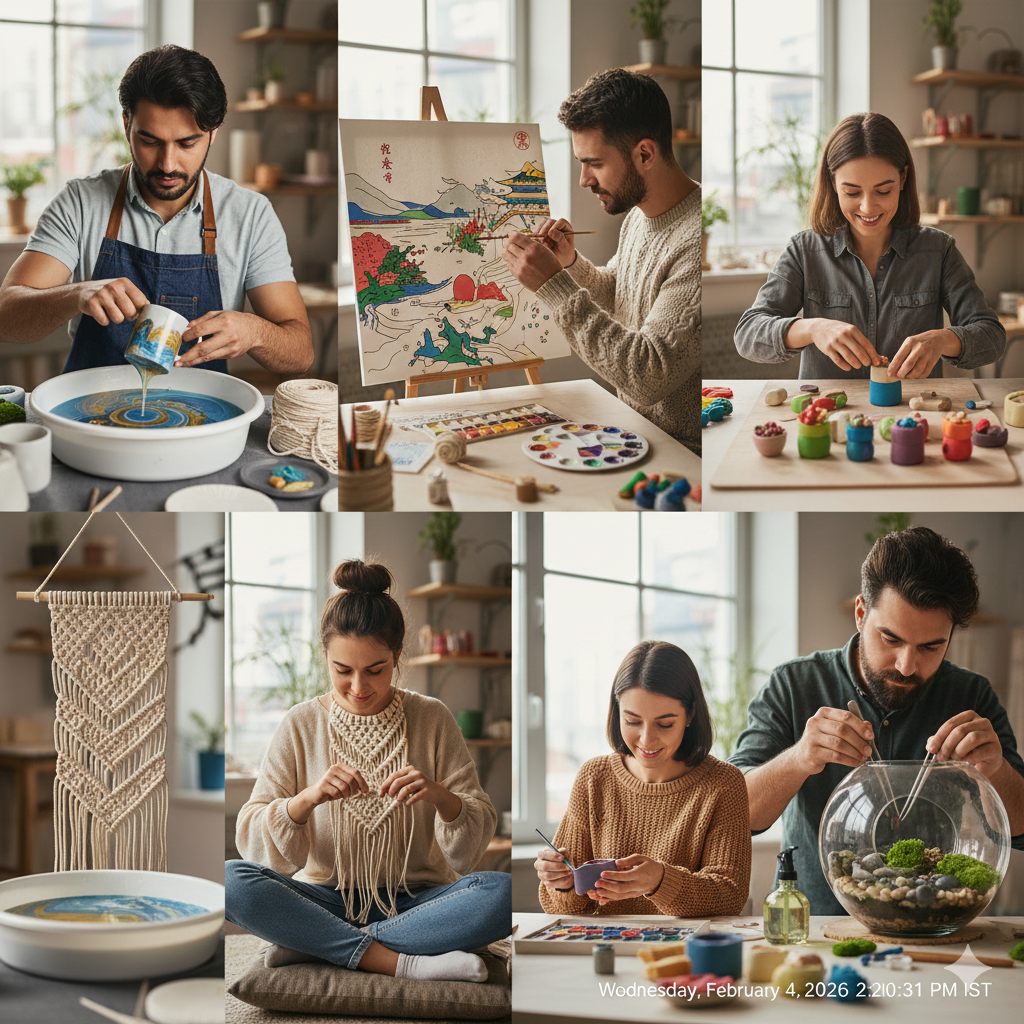
If you are looking to trade your doom-scrolling for a dopamine boost, here are five adult craft ideas that are proven to help lower the volume on life’s stress.
1. The “Magic Trick” of Hydro Dipping
If you want a craft that offers high reward for relatively low effort—and looks absolutely incredible—you need to look into hydro dipping.
Also known as hydrographics, this process involves applying printed designs to three-dimensional objects using water. It sounds high-tech, but thanks to modern DIY kits, you can easily do it in your garage or backyard.
The Stress-Relief Factor: The beauty of this craft lies in the reveal. There is a specific moment of anticipation that forces you to be entirely present. Here is how it usually works: you fill a container with water, lay a patterned film on the surface (anything from carbon fiber textures to wood grain or wild camouflage), spray it with an activator, and then slowly dip your object through the film.
As you pull the object out, the design wraps perfectly around every curve and corner. It feels like a magic trick every single time. Taking a boring, scuffed-up item—like an old video game controller, a tumbler, or a car part—and instantly transforming it into a custom piece of art provides a massive rush of satisfaction. It’s messy, it’s fun, and it completely distracts you from whatever was worrying you at the office.
2. The Rhythmic Calm of Macramé
Macramé had a huge moment in the 1970s, and it has come back with a vengeance for good reason. It is essentially the art of tying knots in cord to create patterns, plant hangers, or wall tapestries.
The Stress-Relief Factor: While hydro dipping is about the excitement of the transformation, macramé is about the rhythm. It relies on repetitive motion. Once you learn the basic knots (like the square knot or the half-hitch), your hands take over, and your brain can check out.
This type of bilateral rhythmic movement has been shown to calm the nervous system. It is very similar to the effect of knitting or crocheting, but with a lower barrier to entry because you don’t need needles or hooks—just your hands and some rope. The tactile sensation of the cotton cord and the repetitive nature of the knotting acts as a form of moving meditation. Plus, at the end of the session, you have a physical object that adds a touch of boho chic to your home, giving you a visual reminder of your calm capability.
3. Structured Creativity with Paint-by-Numbers
Sometimes, the idea of a blank canvas is more stressful than relaxing. Decision fatigue is a real phenomenon for adults. After a long day of making hard choices at work, the last thing you want to do is figure out composition, color theory, and shading. This is why adult paint-by-numbers kits have exploded in popularity.

The Stress-Relief Factor: This craft outsources the executive functioning part of your brain. You don’t have to decide what to paint or which blue to use for the sky. The instructions tell you exactly what to do.
This structure provides a safety net. It allows you to engage in the physical act of painting—the feeling of the brush on canvas, the mixing of pigments—without the fear of messing it up. It appeals to the part of the brain that craves order. Seeing a chaotic jumble of tiny numbered shapes slowly transform into a coherent image is deeply satisfying and gives a sense of control that everyday life often lacks.
4. The Grounding Power of Polymer Clay
If you are someone who carries stress as physical tension (clenched jaw, tight shoulders), working with clay might be your best outlet. Polymer clay is an accessible modeling material that doesn’t require a kiln; you just bake it in your home oven to set it.
The Stress-Relief Factor: Clay is tactile. It requires force. You have to knead it, warm it up, roll it, and shape it. This physical engagement is incredibly grounding. It connects you to your sense of touch in a way that typing on a keyboard never will.
You can make anything from intricate jewelry and earrings to small succulent planters or ring dishes. The forgiving nature of the medium is key here; if you don’t like what you made, you just smash it into a ball and start over. There is zero waste and zero pressure. It encourages a playful mindset that adults rarely get to experience.
5. Terrarium Building
If you crave time in nature but live in a concrete jungle (or just have bad weather), bring the nature to your table. Building a terrarium is essentially landscaping in miniature. You use glass containers, pebbles, activated charcoal, soil, moss, and small humidity-loving plants to create a self-contained ecosystem.
The Stress-Relief Factor: Gardening of any kind is linked to lower levels of depression and anxiety, but terrarium building adds a layer of focus and design. You are playing God in a jar. You have total control over this tiny world.
Arranging the moss, placing a specific stone just right, and misting the leaves requires a delicate touch and slows your breathing. Once it is built, a closed terrarium is low maintenance, but watching the water cycle happen inside the glass—condensation forming and “raining” back down on the plants—is a passive stress reliever that sits on your desk long after the project is finished.
Just Make Something
We often hesitate to start a craft because we are afraid of being bad at it. We worry that we are wasting money on supplies or that the final result won’t look like the pictures on Pinterest.
But the goal of these activities isn’t to launch an Etsy shop or get famous on Instagram. The goal is the process itself. It is about claiming an hour of your life where you are the creator, not the consumer.
Whether you are dipping a helmet in a hydrographic tank or tying knots in the living room, the act of making something uselessly beautiful is a defiant act against the grind of modern life. So pick a project, get your hands dirty, and let your brain take the break it deserves.

- The Sleep-Well Account: Why Your Nest Egg Is Actually a Mental Health Tool - February 25, 2026
- A Guide for Turning Your RV into a Sanctuary for Sleep - February 4, 2026
- High Stakes, Low Blood Pressure: How to Navigate the Chaos of Moving Hazardous Liquids - February 4, 2026
This site contains affiliate links to products. We will receive a commission for purchases made through these links.