Skip to content
As a BetterHelp affiliate, we receive compensation from BetterHelp if you purchase products or services through the links provided
Every reflexology studio has one: a wall chart of two feet, covered in a lattice of zones, each zone labeled with an organ it claims to govern. The heart sits on the left arch, the sinuses curl around the toes, the spine runs the inner edge from heel to ball. The chart is the treatment’s entire theory drawn in one image, pressure applied to a zone travels to its organ, and it is either the most underrated map in wellness or the most durable piece of anatomical fiction ever sold as healthcare. Unusually for a spa menu item, the question has actually been studied, by the same federal reviewers who audit every complementary practice sold in the United States.
The honest answer they produced is more interesting than either the believers or the scoffers expected. Reflexology has not been validated as the organ-telegraph its charts describe. It has not been dismissed either. A modest body of research, built on patients rather than philosophy, keeps finding real effects in real people, just not the effects the wall chart promises, and the gap between those two sentences is where the treatment actually lives.
One Premise, Drawn Large
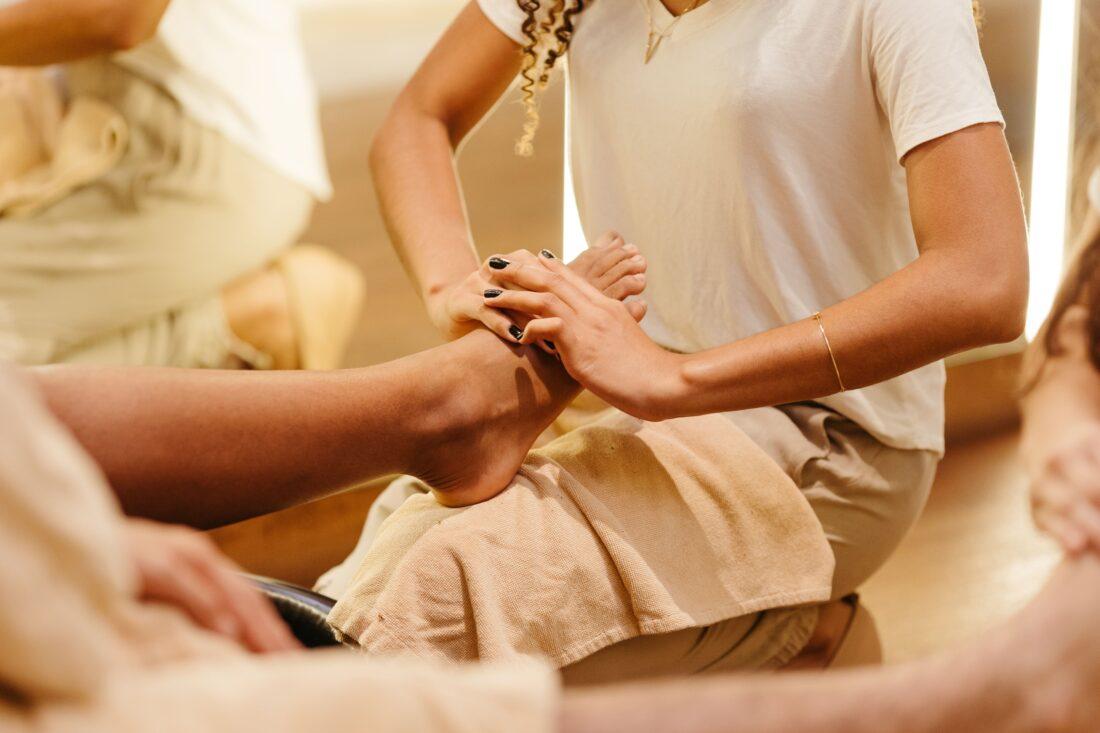
Reflexology, in its modern form, is about a century old, and its premise has stayed stable: the feet are a miniature map of the body, and skilled pressure on specific points influences the organs those points represent. Practitioners are trained in the map, sessions run thirty to sixty minutes, and the treatment is a fixture on spa menus across the world, usually described as deeply relaxing by people who did not walk in believing anything about organs.
The National Center for Complementary and Integrative Health, the NIH institute that audits this territory, classifies reflexology as a practice in which pressure is applied to specific points, and its overview of reflexology is careful to separate what the practice claims from what studies have measured. That separation is the entire ballgame. The claim is organ-specific influence. The measurements track symptoms, pain scores, fatigue, anxiety, sensations, and the measurements do not care which zone the practitioner believes they are pressing.
What The Federal Reviewers Found
The institute’s summary reads like a chart of its own, mapping claims to evidence. For most conditions, the research is limited, of uneven quality, or unresolved. For a few, the file is thicker. A small body of work suggests reflexology may help reduce the burning, prickling sensation that some people with multiple sclerosis experience in their extremities. The center’s materials on chronic pain and complementary approaches note that practices in this family, including reflexology and acupressure, may be helpful for cancer pain, a sentence that carries weight precisely because of the audience it describes.
The strongest pattern in the literature is quieter than any single finding. A 2022 review of foot reflexology research, indexed through the National Library of Medicine, catalogued a decade of trials and found recurring, moderate effects on anxiety and fatigue, particularly among people in cancer treatment. Reviewers in this field are professional skeptics by job description, and even they keep concluding that something measurable happens on the treatment table, even when the something refuses to attach itself to the wall chart’s geography.
The Claim On The Chart | What The Research File Shows |
| Points influence specific organs | No mechanism demonstrated |
| Relief of burning, prickling sensations | Possible benefit found in MS studies |
| Help with cancer pain | Named among options that may help |
| Reduced anxiety and fatigue | Recurring moderate effect in trials |
| A cure for disease | Nothing in the file supports this |
A Comfort With A Footnote
The safety profile is where reflexology earns its spa slot. The institute describes it as generally safe when delivered by trained practitioners, with the standard cautions reserved for the usual populations, people with foot injuries, circulation disorders, or serious chronic conditions belong in a conversation with a clinician first. The real risks are financial and medical in the broader sense: money spent on sessions sold as organ treatment, and, more seriously, delays in real diagnosis when a treatment is trusted beyond its file.
That footnote matters most at the edges of the practice. Reflexology sold as relaxation is honest about itself, and the research suggests it delivers. Reflexology sold as a diagnostic technique, where a practitioner claims to read illness from tender points, wanders off the evidence entirely and into territory where the federal reviewers have found nothing to audit. A treatment can be genuinely calming and falsely diagnostic at the same time, and the customer’s job is to buy the first without funding the second.
The spa world has mostly made peace with this arrangement, and treatment guides that catalogue modalities, like the spa and aesthetics coverage on E-Taller, increasingly describe reflexology in exactly the split vocabulary the research supports, relaxing, popular, modestly supported for specific symptoms, silent on organ maps. The wall chart still hangs, because wall charts are decoration and decoration is harmless. The interesting question is no longer whether pressing feet does anything. It is whether the industry can keep the honest half of the finding without selling the chart that made the treatment famous.


- When the Horse Is the Therapist - September 17, 2026
- The Government’s Numbers on the Psychology Career - September 17, 2026
- The Diagnoses That Imitate Dementia - September 17, 2026
This site contains affiliate links to products. We will receive a commission for purchases made through these links.